
Transforming how roads are inspected, maintained, and funded.
amehlo.ai is a vision system that transforms how roads are inspected, maintained, and funded by making monitoring continuous, objective, and data-driven instead of periodic and manual.
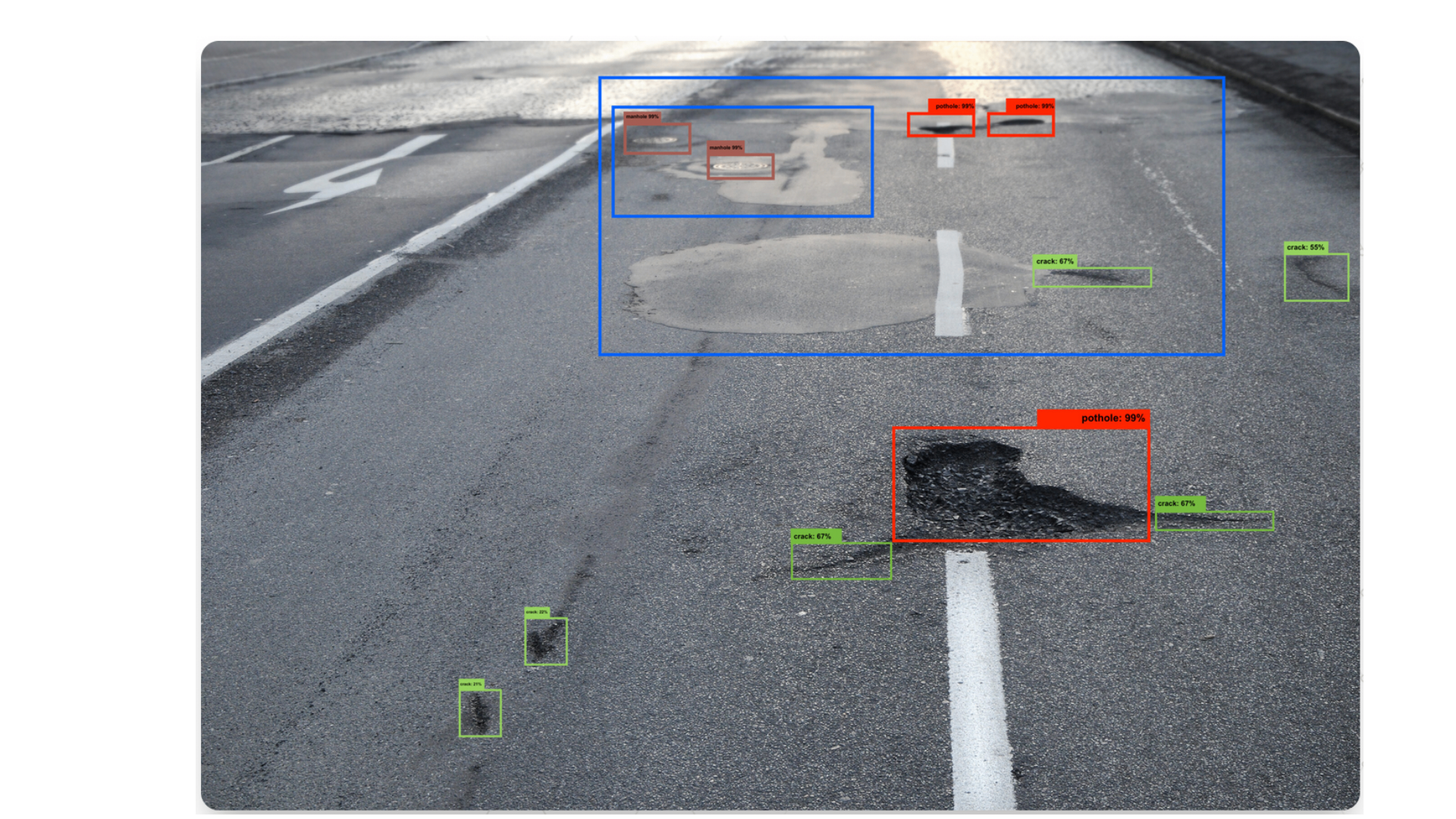
Dimension & depth captured per defect, not just a photo.
Aligned to TMH13 road-assessment methodology.
Most road networks are run on memory, not measurement.
Road authorities, insurers and contractors are still making multi-million-rand resurfacing, claims and budget decisions on the same three inputs: a windshield, a clipboard, and whoever drove that route last. That gap shows up everywhere along the value chain - and one piece of it is exactly where amehlo.ai started.
Manual condition reporting
Cracks, potholes, markings and signage are still logged road-by-road, by hand.
No predictive maintenance
Repairs happen after a road fails, not before.
No real-time infrastructure data
Authorities can't see the actual state of their network on any given day.
High rate of road traffic incidents
Defects that go unflagged become collisions - and liabilities.
Rising motor claims
Insurers absorb infrastructure damage costs they can't independently verify.
Cost of late detection
A crack caught late is a resurfacing project; a backlog caught late is a budget crisis.
No aggregated insight
Data that exists sits in silos, never a system anyone can query.
No labelled local data
Global computer-vision models have never been trained on African road surfaces.
Nobody else has been collecting it. We have, since 2017.
Three layers.
One continuous loop.
Sense → Understand → Act - running on hardware that bolts onto a vehicle you already own.
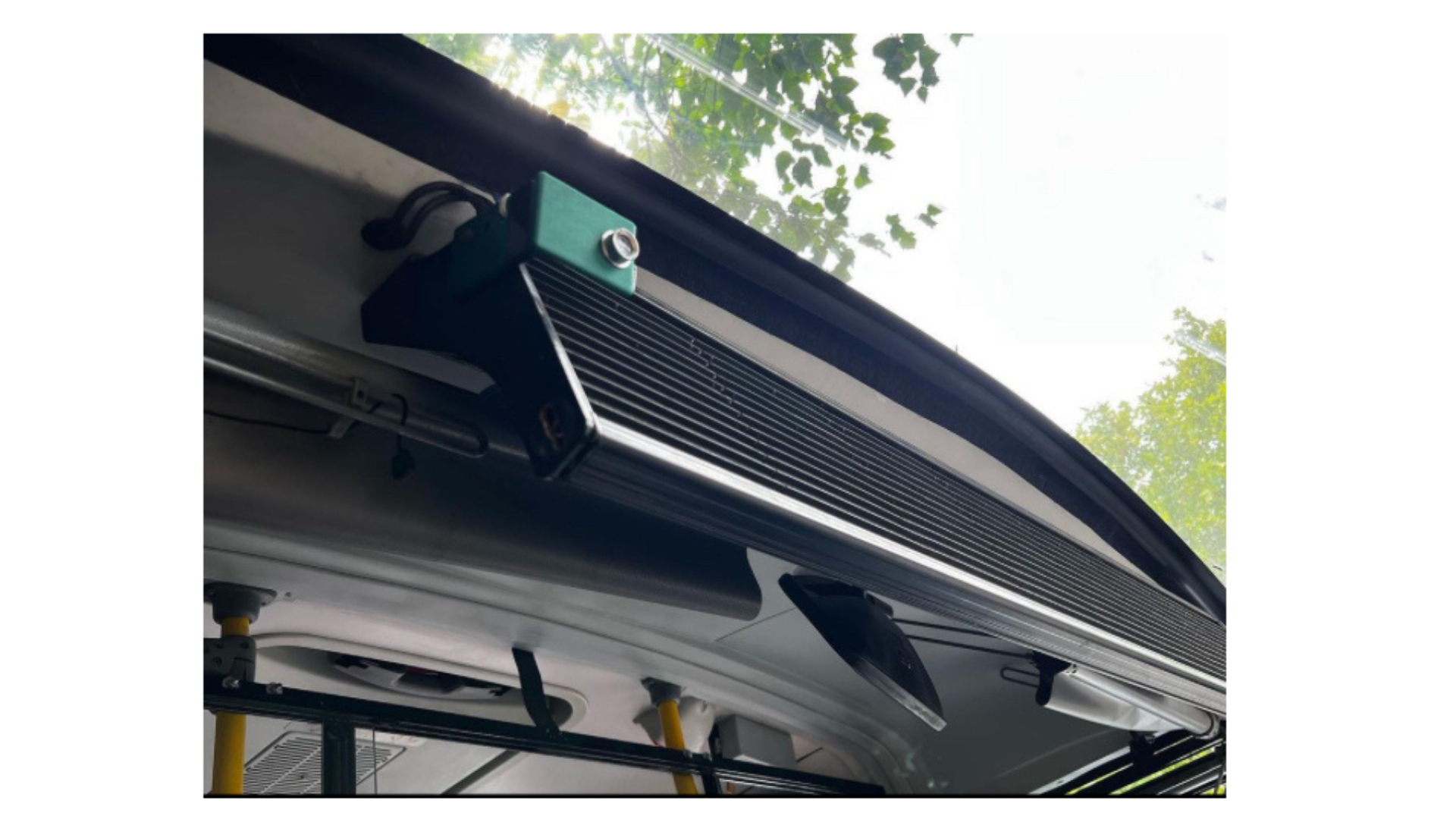
Any vehicle becomes a sensor.
A compact, plug-and-play unit mounts inside municipal trucks, buses, insurer fleets or contractor vehicles. No specialised survey vehicle, no downtime to fit it.
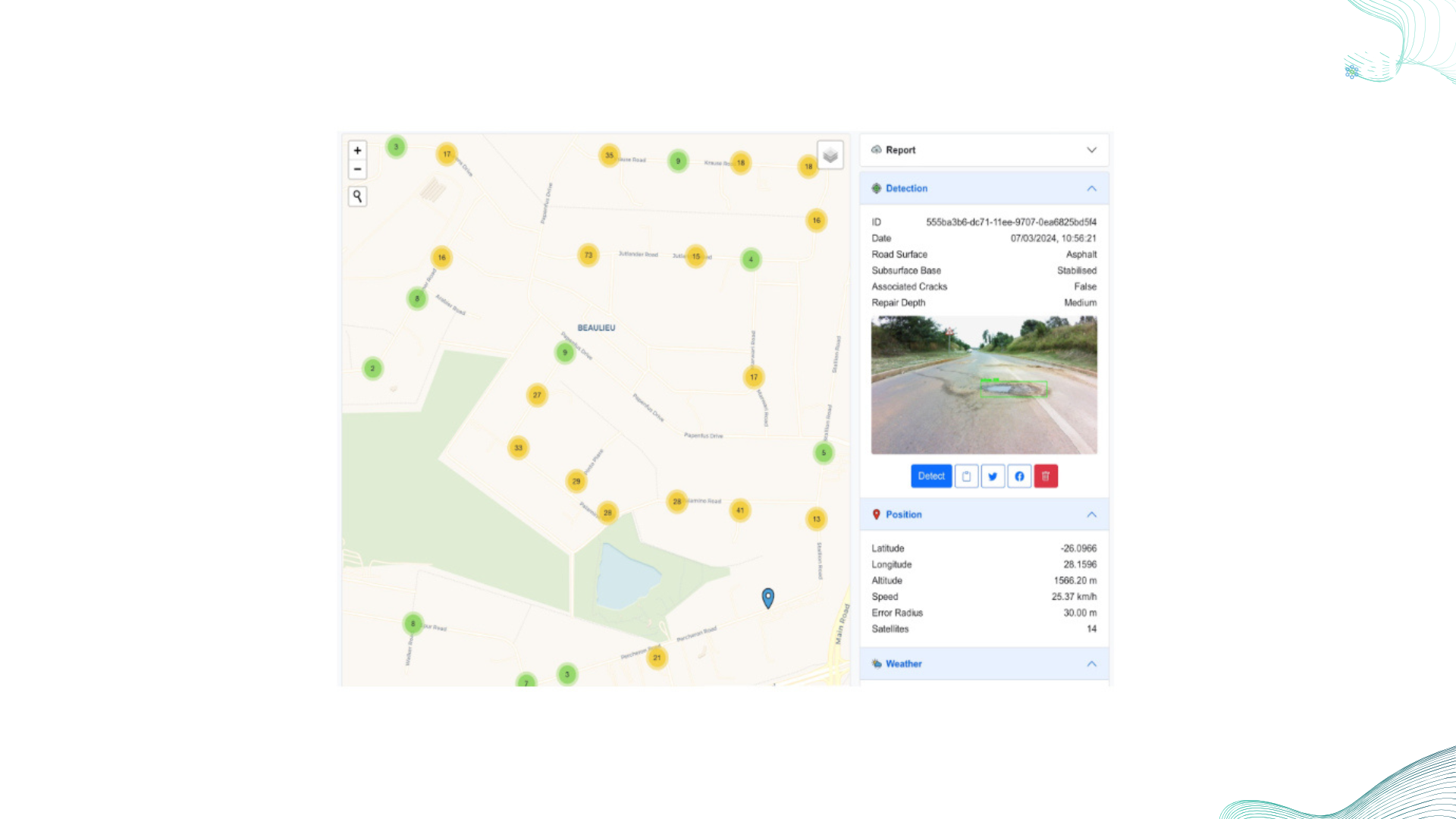
Every defect, sized and located.
Computer-vision models trained on African road conditions classify, size and place every pothole, crack, faded marking and damaged sign - automatically, no human reviewer in the loop.
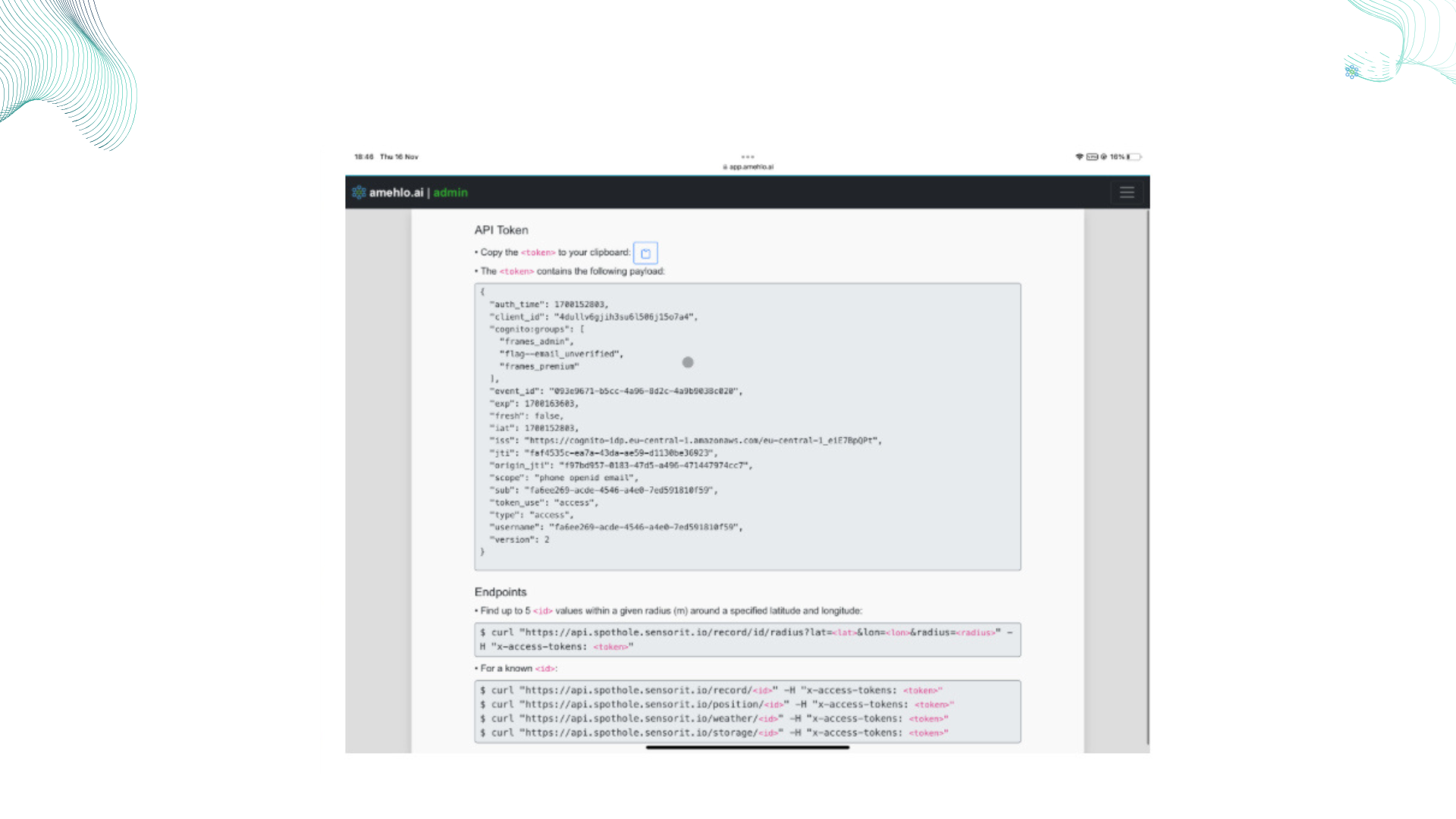
Lands where work already happens.
A dashboard built for the people who fund and fix roads, plus a RESTful API into the ERP, SAP or insurance system already in use.
And it scales down, not just up. The same pipeline that runs amehlo.ai's autonomous sensor network also powers Standalone citizen facing applications and reporting layer communities use to log potholes by hand - feeding the same dataset the autonomous fleet builds continuously, at scale.
The data is the company.
Every kilometre amehlo.ai drives adds to a proprietary, labelled dataset of African road conditions - the exact training data global vision platforms have never had access to.
Detections land directly inside the SAP, ERP and insurance incident-management systems road authorities and insurers already run - instead of asking them to adopt a new platform.
Plug-and-play hardware on ordinary vehicles keeps cost-per-kilometre low enough to reach gravel and rural roads - networks highway-only inspection systems were never built to cover.
Black-owned, B-BBEE Level 1, manufactured and supported locally, with skills transfer built into every deployment - the operating model public procurement is actually designed to favour.
The underlying method is peer-reviewed and published in IEEE Access, built with the University of Cape Town's Radar Remote Sensing Group - not just a claim in a pitch deck.
From one pothole to a living map of the network.
amehlo.ai already tracks eight categories of road asset autonomously, with no human in the loop - and calculates dimension and depth for every pothole and crack, not just a photograph of it.
Two ways in. One dataset.
- 01Citizen App
Manual defect logging by communities and field teams, via Amehlo.ai Citizen App.
- 02Autonomous network
Continuous, automatic capture with no human intervention, plus size, depth and location data the citizen layer can't produce.
- 03Integrated M&E
Both feed one integrated measurement and evaluation system - built to plug into the asset-management tools authorities already run.
Already running on real networks - not just in the deck.
University of Cape Town
Pothole & crack imagery and sizing, pavement condition assessment, overhanging vegetation, all geo-located and timestamped.
Connected into an enterprise resource planning system.
SANRAL
Pothole imagery, location, defect severity and road surface type, gathered fully autonomously.
Standalone pilot, no system integration in this phase.
Drive Pulse
Pothole imagery, location, date and time, captured continuously from fleet vehicles already on the road.
Connected directly into an insurance incident-management system.
Road to Repair (R2R): An Afrocentric Sensor-Based Solution to Enhanced Road Maintenance.
D.A. Jordan, S. Paine, A.K. Mishra, J. Pidanic - published in IEEE Access, 12 January 2023. DOI 10.1109/ACCESS.2023.3236401.
A collaboration between Sensorit (Pty) Ltd, the University of Cape Town Department of Electrical Engineering, and the University of Pardubice.
Built in Cape Town. Owned by the people building it.
amehlo.ai is a Black-owned, purpose-driven technology company solving infrastructure problems specific to African roads and African budgets - not a global platform retrofitted for the continent. The vision is a modular, flexible ecosystem built from the ground up to move at the pace of real market need, with a platform local developers can build on rather than wait for.
Combined, the team carries roughly 30 years of industry experience across artificial intelligence, machine learning, IoT and data science - and is committed to building solutions for the people who actually use roads every day, not just the people who fund them.
2nd Floor, Swindon Building, 179 Buitengracht Street, Cape Town, 8001, South Africa
Office 101B, Regent Place, The Zone Mall, Rosebank, Johannesburg, 2196, South Africa
Your network already has the data.
Let's go capture it.
Tell us how many kilometres you're responsible for and what you're flying blind on - we'll show you what amehlo.ai would see in the first week.
Request an infrastructure briefing →